What Is Business Lending? A Complete Guide for Small Business Owners

Running a small business takes more than a great idea. At some point, most owners hit a wall where growth outpaces available cash. Maybe it is a slow season, an unexpected expense, or an opportunity that needs capital to capture. That is where lending business loans comes in, and understanding how it works can be the difference between stalling and scaling.

This guide breaks down what business lending is, how it works, and what small business owners should know before applying for funding.
Key Takeaways
Business lending gives small business owners access to capital for growth, operations, and emergencies.
There are several types of business loans, each suited to different funding needs.
Lenders evaluate your credit, revenue, and time in business before approving a loan.
Direct lenders often offer faster decisions and fewer fees than traditional banks.
Knowing what you need the money for helps you choose the right loan type.
Preparation, including having documents ready, speeds up the approval process.
Table of Contents
What Is Business Lending?
Business lending is the process by which a financial institution or direct lender provides capital to a business that agrees to repay the funds, usually with interest, over a set period. It is one of the most widely used tools for growing a company, covering everything from payroll gaps to equipment purchases to expansion costs.
According to the Federal Reserve's Small Business Credit Survey, nearly half of small business owners applied for financing in the past year, making it a common and accepted practice for businesses at every stage.
Business lending differs from personal lending in one important way: the loan is tied to the financial health and needs of the business, not just the personal finances of the owner.
Common Types of Business Loans
Not all business loans are the same. Understanding the differences helps you choose the right product for your situation.
Loan Type | Best For | Typical Term | Collateral Required? |
Term Loan | One-time large expense | 1 to 5 years | Sometimes |
Line of Credit | Ongoing working capital needs | Revolving | Sometimes |
SBA Loan | Low-rate long-term financing | Up to 25 years | Usually |
Merchant Cash Advance | Fast cash, flexible repayment | 3 to 18 months | No |
Unsecured Business Loan | No-collateral funding | 6 to 36 months | No |
Equipment Financing | Purchasing business equipment | Matches asset life | Equipment itself |
Each product serves a specific purpose. A term loan might make sense if you are buying a piece of equipment. A line of credit works better for covering cash flow gaps. Unsecured business loans are popular among small business owners who do not want to put up collateral.

How Business Lenders Evaluate Your Application
Business lenders review several key factors before approving lending business loans. Understanding these criteria helps you walk in prepared.
The three most common factors lenders weigh are:
Credit Score: Both business and personal credit scores matter. Most lenders prefer a minimum personal credit score of 600, though requirements vary. The U.S. Small Business Administration notes that creditworthiness is a core element of any loan evaluation.
Time in Business: Many lenders require at least six months to two years of operating history. Startups can face more limited options but are not excluded entirely.
Annual Revenue: Lenders want to see that your business generates enough cash flow to repay the loan. Most require a minimum monthly or annual revenue threshold.
Other factors include outstanding debt, industry type, and the purpose of the loan. Being honest and organized about your financials puts you in a stronger position.
Direct Lenders vs. Traditional Banks
When it comes to lending business loans, you have more than one path to funding.
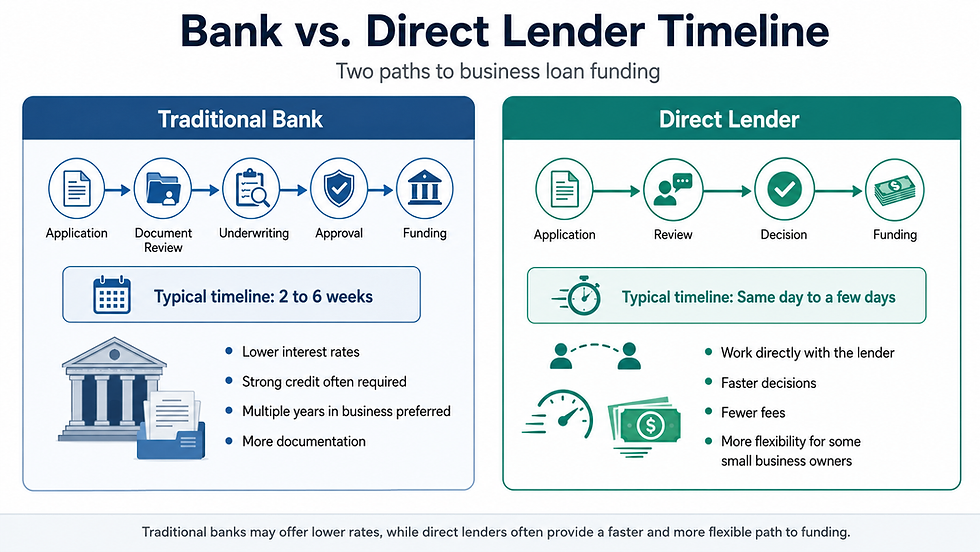
Traditional banks offer lower interest rates but often require strong credit history, multiple years in business, and substantial documentation. The approval process can take weeks.
Direct lenders work with you directly without routing your application through a middleman. This means faster decisions, fewer fees, and more flexibility for small business owners who may not qualify for traditional bank loans.
For many small business owners, a direct lender is the faster and more accessible option, especially when time-sensitive opportunities or urgent cash needs arise.
How to Prepare Before You Apply
Preparation is one of the most overlooked parts of business lending. Having your documents ready can cut approval time significantly.
Here is what most lenders will ask for:
Business bank statements (typically the last 3 to 6 months)
Proof of business ownership (EIN or business license)
Personal identification (government-issued ID)
Profit and loss statement or tax returns
Business plan (sometimes required for larger amounts)
The cleaner and more organized your financial records, the faster your application moves through the system. If you are applying with a direct lender, the process is often streamlined with fewer documents required than a traditional bank.
Are You Ready to Find the Right Funding Option?
DirectLend.AI makes it simple for small business owners to explore lending options without the complexity of traditional banking. Whether you need a short-term boost or a longer-term loan for growth, the team at DirectLend.AI can help you find a solution tailored to your business.
Apply for funding today at DirectLend.AI and get a decision faster than you think.
FAQs About Business Lending
What is the minimum credit score needed for a business loan?
Most lenders require a personal credit score of at least 600, though some direct lenders work with scores as low as 550. Requirements vary based on the loan type and lender's criteria.
How long does it take to get a business loan?
Traditional banks may take 2 to 6 weeks. Direct lenders like DirectLend.AI can often provide a decision within 24 to 48 hours, with funding in as little as one business day.
Can I get a business loan with no collateral?
Yes. Unsecured business loans do not require collateral. They are based on your business revenue and credit profile instead.
What is the difference between a business loan and a line of credit?
A business loan provides a lump sum repaid over a set term. A line of credit gives you a credit limit to draw from as needed, like a business credit card with set terms.
How much can I borrow for a small business loan?
Loan amounts vary widely, from a few thousand dollars to several million, depending on your business revenue, credit score, and the lender's products.
Ready to Explore Your Funding Options?
Business lending should open doors, not create more stress. At DirectLend.AI, we work directly with small business owners to find funding that fits their actual situation, not just a credit number on paper.
If you are ready to take the next step, visit DirectLend.AI to learn more about your options or apply today to get started. A dedicated lending specialist is ready to help you move forward.
References
Federal Reserve Small Business Credit Survey (2024) — Data on small business financing applications and approval rates across the U.S.
U.S. Small Business Administration: Get a Business Loan — Official government guidance on business loan types and lending criteria.


Comments