How to Get Business Funding Without Hurting Your Credit

Securing capital is one of the most critical steps for growing your business, but the fear of damaging your credit score stops many business owners from even exploring their options. We’ve put together a guide on how to get business funding without hurting your credit score.

Every loan application, every credit check, every inquiry feels like a potential threat to your creditworthiness. The good news? You can search for business funding, compare lenders, and explore loan options without hurting your credit score when you know the right strategies.
This comprehensive guide reveals exactly how to navigate the capital search process intelligently. You'll learn the difference between credit inquiries that damage your score and those that don't, discover platforms that protect your credit during the search process, and master strategies that savvy business owners use to secure funding while maintaining excellent credit health.
Whether you're seeking your first business loan, shopping for competitive rates, or exploring multiple financing options simultaneously, this article provides the roadmap to finding capital without credit score consequences.
Key Takeaways
Soft credit inquiries don't affect your credit score and are ideal for initial capital searches and pre-qualifications
Hard credit inquiries can lower your credit score by 5-10 points each, but rate shopping within 14-45 days counts as a single inquiry
Platforms like DirectLend AI offer no-credit-impact matching, allowing you to explore lenders without triggering hard inquiries
Pre-qualification processes using soft pulls let you see potential rates and terms before formal applications
Strategic timing of loan applications minimizes credit damage while maximizing your funding options
Monitoring your credit report regularly (free at annualcreditreport.com) helps you track inquiries and identify errors
Multiple hard inquiries within short periods signal financial distress to lenders, reducing approval odds
Table of Contents
Understanding Credit Scores and Why They Matter for Business Funding
The Critical Difference Between Hard and Soft Credit Inquiries
Smart Strategies for Searching Business Capital Without Credit Damage
How DirectLend AI Protects Your Credit During Lender Matching
Common Credit Mistakes Business Owners Make When Seeking Funding
Understanding Credit Scores and Why They Matter for Business Funding
Your credit score is a three-digit number ranging from 300 to 850 that represents your creditworthiness to lenders. For business owners, this number often determines whether you'll be approved for financing, what interest rates you'll pay, and how much capital you can access.

What Impacts Your Credit Score

Five primary factors determine your credit score:
Payment history (35%) - Your track record of on-time payments on credit cards, loans, and other obligations
Credit utilization (30%) - The percentage of available credit you're using across all accounts
Length of credit history (15%) - How long you've had credit accounts open
Credit mix (10%) - The variety of credit types you manage (credit cards, installment loans, mortgages)
New credit inquiries (10%) - Recent applications for new credit accounts
That final category is where many business owners unknowingly sabotage themselves during the capital search process. Each hard inquiry can lower your score by 5-10 points, and multiple inquiries signal financial distress to lenders.
Why Your Credit Score Matters When Seeking Business Capital

Lenders use your personal credit score (and business credit score, if established) to assess risk. According to the Federal Reserve's research on small business lending, credit scores significantly influence both approval rates and loan terms:
740+ credit score - Qualify for the best rates (often 6-8% APR), highest loan amounts, and most favorable terms
670-739 credit score - Good approval odds with moderate rates (typically 8-12% APR)
580-669 credit score - Limited options, higher rates (12-20% APR), may require collateral
Below 580 - Difficult to secure traditional financing, alternative lenders only, rates exceeding 20% APR
A difference of just 50 points in your credit score can mean thousands of dollars in additional interest over the life of a business loan. This is precisely why protecting your credit during the search process is so critical.
The Critical Difference Between Hard and Soft Credit Inquiries

Not all credit checks are created equal. Understanding the distinction between hard and soft inquiries is fundamental to searching for capital without credit damage.
Type of Inquiry | Impact on Credit Score | When It Occurs | Visible to Other Lenders |
Soft Inquiry | No impact (0 points) | Checking your own credit, pre-qualification offers, background checks, existing creditor reviews | No (only you see these) |
Hard Inquiry | Small impact (5-10 points per inquiry) | Formal loan applications, credit card applications, new account openings | Yes (visible for 2 years, impacts score for 12 months) |
Soft Credit Inquiries Explained

A soft credit inquiry (also called a soft pull or soft credit check) occurs when your credit is reviewed but you're not actively applying for new credit. These inquiries don't affect your credit score because they don't indicate you're taking on new debt obligations.
Common situations involving soft inquiries:
Checking your own credit report at annualcreditreport.com
Pre-qualification or pre-approval offers from lenders
Employer background checks
Insurance quote comparisons
Existing creditors reviewing your account for credit limit increases
Lender matching platforms like DirectLend AI that screen your profile without pulling credit
Soft inquiries appear on your credit report when you view it, but they're invisible to lenders evaluating your creditworthiness. You can have dozens of soft inquiries without any negative consequences.
Hard Credit Inquiries Explained

A hard credit inquiry (also called a hard pull or hard credit check) happens when you formally apply for new credit and authorize a lender to review your full credit report to make a lending decision. These inquiries signal to the credit bureaus that you're seeking new debt, which slightly increases your perceived risk.
Common situations involving hard inquiries:
Submitting a formal business loan application
Applying for a credit card
Applying for a mortgage or auto loan
Opening a new business line of credit
Leasing equipment with credit approval
Each hard inquiry typically reduces your credit score by 5-10 points and remains visible on your credit report for two years, though it only impacts your score calculation for the first 12 months.
How Credit Inquiries Actually Impact Your Credit Score
The impact of credit inquiries depends on several factors including the number of inquiries, their timing, and your overall credit profile.
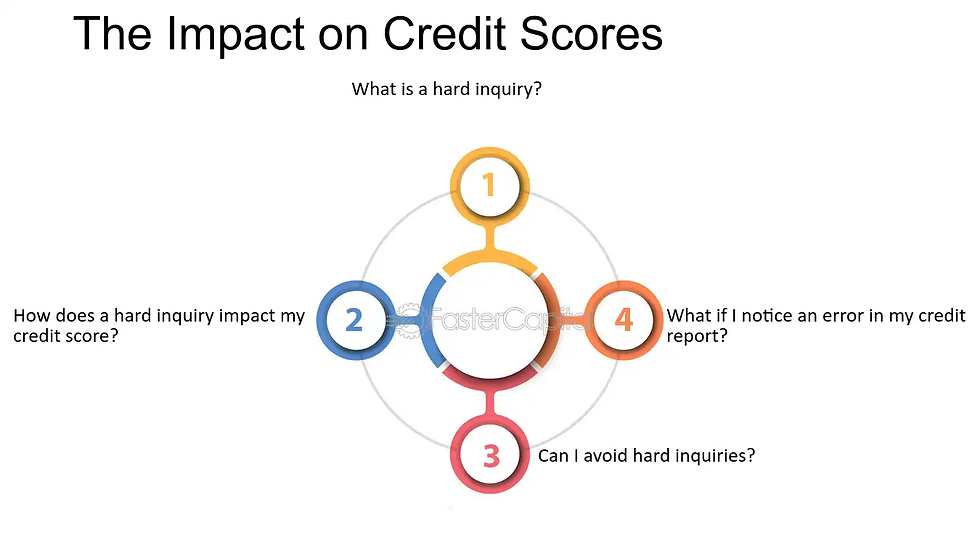
Single Hard Inquiry Impact
One hard inquiry typically causes a minor, temporary decrease of 5-10 points. For someone with a strong credit profile (750+ score), this barely registers and recovers quickly. For someone with a thinner credit file or lower score, the impact can be more pronounced.
Multiple Hard Inquiries: The Real Danger
The real credit damage occurs when you accumulate multiple hard inquiries within a short timeframe. Here's why this matters:
Scenario 1: Scattered Applications Over 6 Months
Month 1: Apply for business loan (hard inquiry) - Score drops 7 points
Month 3: Apply for business credit card (hard inquiry) - Score drops another 8 points
Month 5: Apply for equipment financing (hard inquiry) - Score drops another 6 points
Total impact: 21-point decrease, signals financial distress
Scenario 2: Strategic Rate Shopping Within 30 Days
Week 1: Apply to 5 different business lenders for the same loan type
Total impact: Treated as single inquiry, 5-10 point decrease
Credit scoring models recognize legitimate rate shopping and employ a "deduplication" period where multiple inquiries for the same loan type count as one inquiry if they occur within 14-45 days (the window varies by scoring model).
Long-Term Effects on Your Credit
Hard inquiries affect your credit score for 12 months but remain visible on your report for 24 months. After the first year, their impact disappears from score calculations, though lenders can still see them when reviewing your application.
Multiple inquiries create a compounding problem. Each subsequent lender sees your previous inquiries and may question why you've been declined elsewhere or why you're desperately seeking credit across multiple sources. This perception can lead to:
Higher interest rate quotes (risk-based pricing)
More stringent documentation requirements
Lower loan amount approvals
Outright application denials
Soft Credit Checks: Your Secret Weapon for Capital Searches

Soft credit inquiries are your most powerful tool for exploring business funding options without consequences. Savvy business owners leverage soft pulls extensively before ever submitting formal applications.
Where to Get Free Soft Credit Checks

This is the only federally authorized source for free credit reports from all three major credit bureaus (Equifax, Experian, TransUnion). You're entitled to one free report from each bureau annually, which means you can check your credit three times per year by staggering your requests.
2. Credit Monitoring Services
Many free services like Credit Karma, Credit Sesame, and NerdWallet provide regular soft credit checks and credit score monitoring. While they may use VantageScore instead of FICO scoring models, they're useful for tracking trends and identifying issues.
3. Your Bank or Credit Card Issuer
Many financial institutions now offer free FICO scores as a customer benefit. Check with your bank, credit union, or credit card company to see if they provide complimentary credit score access.
Using Soft Inquiries for Pre-Qualification

Pre-qualification is the process where lenders provide estimated loan terms based on basic information and a soft credit pull. This allows you to:
See what interest rates you might qualify for
Understand potential loan amounts available to you
Compare offers from multiple lenders
Make informed decisions before triggering hard inquiries
The key phrase to look for is "won't affect your credit score" or "soft credit check only" during the pre-qualification process. Legitimate pre-qualification should never require authorization for a hard pull.
Lender Matching Platforms Using Soft Inquiries

Modern technology has revolutionized how business owners search for capital. Platforms like DirectLend AI analyze your business profile and match you with appropriate lenders without performing credit checks during the initial matching phase.
These platforms typically work by:
Collecting basic business information (revenue, time in business, loan needs)
Matching your profile against lender requirements using algorithms
Showing you compatible lenders without pulling credit
Allowing you to choose which lenders to contact for formal applications
This approach lets you explore dozens of potential lenders, compare estimated terms, and make strategic decisions about where to formally apply without accumulating damaging hard inquiries.
Smart Strategies for Searching Business Capital Without Credit Damage

Protecting your credit score while searching for business funding requires strategic planning and disciplined execution. Follow these proven approaches:
Strategy 1: Research and Pre-Qualify Before Applying

Never submit formal loan applications without first researching lenders and completing pre-qualification processes. This preliminary work should involve only soft inquiries.
Step-by-step approach:
Identify your funding needs - Determine exactly how much capital you need, for what purpose, and your ideal repayment timeframe
Check your credit scores - Know your starting point using annualcreditreport.com or credit monitoring services
Research lender requirements - Each lender publishes minimum credit scores, revenue requirements, and time-in-business criteria
Complete pre-qualifications - Submit information to multiple lenders offering soft-pull pre-qualification
Compare pre-qualified offers - Evaluate rates, terms, and conditions across all options
Select top 2-3 lenders - Choose the most competitive offers for formal applications
Submit formal applications within 14 days - This timeframe ensures they count as a single inquiry for rate shopping
This methodical approach means you're only triggering hard inquiries with lenders highly likely to approve your application at competitive terms.
Strategy 2: Leverage the Rate Shopping Window

Credit scoring models from FICO and VantageScore recognize that consumers and business owners need to shop for the best rates. They created "rate shopping windows" that treat multiple hard inquiries for the same loan type as a single inquiry.
FICO rate shopping windows:
Older FICO models: 14-day window
FICO 8 and newer: 45-day window for mortgages, auto loans, and student loans
Business loans: Typically 14-30 day window (varies by lender and scoring model used)
How to use this strategically:
Once you've pre-qualified and selected your top lender options, submit all formal applications within a concentrated 14-30 day period. Even if this results in 5-7 hard inquiries, they'll be counted as a single inquiry for scoring purposes.
Important caveat: This deduplication only works for the same loan type. Applying for a business term loan, a business credit card, and equipment financing simultaneously will result in three separate inquiries because they're different product types.
Strategy 3: Use DirectLend AI's No-Credit-Impact Matching

DirectLend AI solves the credit inquiry problem by matching you with qualified lenders before any credit checks occur. The platform's AI algorithm analyzes over 50 business data points including:
Annual revenue and monthly cash flow
Time in business and industry type
Estimated credit score range (you provide, no verification needed initially)
Loan amount and intended use
Business location and structure
The system then matches you against requirements from 75+ verified lenders, showing you which lenders are most likely to approve your application. You can review these matches, compare estimated terms, and choose which lenders to contact for formal applications.
The credit protection advantage:
By front-loading the matching process with data analysis instead of credit pulls, you avoid the "spray and pray" approach where business owners submit 10+ applications hoping for approval. Instead, you make informed decisions about where your application has the highest probability of success, typically requiring only 2-3 formal applications (and therefore 2-3 hard inquiries) to secure funding.
Start your no-credit-impact search with DirectLend AI's free 2-minute questionnaire.
Strategy 4: Space Out Non-Essential Credit Applications

While rate shopping for the same loan type enjoys deduplication protection, mixing different credit types doesn't. If you're seeking business funding, avoid simultaneously:
Opening new personal credit cards
Applying for auto loans or mortgages
Applying for retail store credit
Co-signing loans for others
These additional hard inquiries compound with your business loan inquiries, creating a concerning pattern for lenders. Space non-essential credit applications at least 3-6 months apart from your business funding search.
Strategy 5: Monitor Your Credit Report for Errors

According to a Federal Trade Commission study, approximately 20% of consumers have errors on their credit reports that could negatively impact their scores. Before searching for capital:
Pull reports from all three bureaus - Errors may appear on one bureau but not others
Review for inaccuracies - Look for accounts you don't recognize, incorrect balances, outdated information, or duplicate entries
Dispute errors immediately - Each bureau has an online dispute process that typically resolves within 30 days
Document everything - Keep records of disputes and resolutions
Cleaning up your credit report before seeking capital can boost your score by 20-50 points if significant errors exist, potentially qualifying you for better rates and terms.
Using Pre-Qualification to Your Advantage

Pre-qualification is the bridge between browsing and applying. When used correctly, it provides valuable intelligence without credit consequences.
What Pre-Qualification Tells You
A legitimate pre-qualification process using soft credit checks provides:
Estimated interest rate ranges - Not your final rate, but a ballpark based on your profile Approximate loan amounts - How much the lender might be willing to lend Potential repayment terms - Loan length options available to you Required documentation - What you'll need for formal application Likelihood of approval - Some platforms provide probability percentages
Pre-Qualification vs. Pre-Approval: Understanding the Difference
Aspect | Pre-Qualification | Pre-Approval |
Credit Check Type | Soft inquiry (no impact) | Usually hard inquiry (affects score) |
Information Verified | Self-reported, not verified | Documentation verified by lender |
Binding on Lender | Not binding, estimates only | Conditional commitment to lend |
Time Investment | 5-10 minutes | 1-3 hours with documentation |
Best Used For | Initial shopping and comparison | Final decision before application |
Always start with pre-qualification (soft inquiry) to narrow your options, then move to pre-approval (potentially hard inquiry) only with your top choice.
Red Flags: When "Pre-Qualification" Isn't Actually Soft
Some lenders use misleading language. Watch for these warning signs that indicate a hard inquiry:
Requiring your social security number before providing any information
Asking you to authorize a credit check without specifying "soft" inquiry
Terms like "submit application" or "apply now" instead of "get pre-qualified"
No mention of "won't affect your credit score" in their marketing
When in doubt, explicitly ask: "Is this a soft inquiry that won't affect my credit score, or will this be a hard inquiry?" Reputable lenders will answer clearly.
How DirectLend AI Protects Your Credit During Lender Matching

Traditional loan shopping creates a catch-22: you can't know if you'll be approved without applying, but applying hurts your credit and reduces future approval odds. DirectLend AI breaks this cycle with intelligent matching that protects your credit throughout the process.
The DirectLend AI Credit Protection Process
Step 1: Complete the Questionnaire (No Credit Pull)
You provide essential business information including industry, revenue, time in business, estimated credit score range, and funding needs. This takes approximately 2 minutes and requires no credit authorization.
Step 2: Receive Instant AI-Powered Matches (No Credit Pull)
DirectLend AI's algorithm analyzes your profile against requirements from 75+ lenders, identifying which ones are most likely to approve your application based on your actual business characteristics. This matching happens in under 60 seconds.
Step 3: Review Lender Options (No Credit Pull)
You see personalized matches with transparency about each lender's typical requirements, rates, terms, and approval timelines. You can compare options, read reviews, and research each lender without any credit inquiries.
Step 4: Choose Which Lenders to Contact (You Control When Hard Inquiries Occur)
Unlike traditional broker services or marketplace platforms that blast your information to dozens of lenders (triggering multiple credit checks), DirectLend AI puts you in control. You decide which lenders to contact and when to authorize credit checks.
Step 5: Apply Strategically (Minimize Hard Inquiries)
Because you're only contacting lenders highly compatible with your profile, you typically need just 2-3 formal applications to secure competitive offers. This targeted approach minimizes hard inquiries while maximizing approval probability.
Why This Approach Protects Your Credit Better Than Alternatives
Traditional Broker: Sends your application to 20+ lenders simultaneously, triggering 20+ hard inquiries before you even know your options.
Generic Loan Marketplaces: Display estimated rates that often don't match reality, leading to multiple applications and rejections.
Direct Lender Applications: Applying one-by-one without matching means trial-and-error that accumulates damaging inquiries.
DirectLend AI: Pre-matches you with compatible lenders, shows you options without credit pulls, and empowers strategic application timing to minimize hard inquiries while maximizing approvals.
Protect your credit while finding the best lenders for your business. Start your free DirectLend AI assessment now.
Rate Shopping Without Credit Score Consequences

Rate shopping is essential for securing the best loan terms, but only when done correctly. Here's how to compare rates across multiple lenders without accumulating credit damage:
The 14-45 Day Rule for Business Loans
While mortgage rate shopping enjoys a clear 45-day window under newer FICO models, business loan inquiries operate in a gray area. Most scoring models apply a 14-30 day deduplication window for business loans, though this varies by the specific FICO version lenders use.
Conservative approach (recommended): Submit all formal business loan applications within 14 days to ensure they're counted as a single inquiry across all scoring models.
Moderate approach: Submit applications within 30 days, understanding that some scoring models may count them separately.
Documenting Your Rate Shopping
Some lenders may question multiple recent inquiries even if they occurred within the rate shopping window. Prepare a brief explanation:
"I was comparing business loan offers from multiple lenders to secure the most competitive terms for my company. All applications were submitted within a two-week period as part of responsible rate shopping, which credit scoring models treat as a single inquiry."
This proactive explanation demonstrates financial sophistication rather than desperation.
What Constitutes "The Same Type of Loan"
Remember that deduplication only applies to the same loan category:
Same type (deduplicated):
SBA 7(a) loan from five different lenders
Term loans for business expansion from multiple banks
Business lines of credit from various financial institutions
Different types (separate inquiries):
SBA loan + business credit card + equipment financing
Term loan + merchant cash advance + personal loan
Focus your rate shopping on one specific product type at a time to maximize deduplication benefits.
Improving Your Credit While Searching for Capital

You don't have to wait for perfect credit before seeking business funding, but strengthening your credit profile during the search process improves your options and terms.
Quick Credit Improvements (30-90 Days)
Action | Impact on Credit Score | Timeline |
Pay down credit card balances below 30% utilization | +20 to +50 points | Reports within 30-45 days |
Dispute and remove credit report errors | +10 to +50 points per error | 30-60 days for resolution |
Become an authorized user on someone's excellent credit account | +10 to +30 points | Reports within 30-60 days |
Pay off a collections account in exchange for deletion | +30 to +80 points | Immediate upon reporting |
Request credit limit increases on existing cards | +10 to +20 points | Immediate if no hard pull required |
Strategic Credit Utilization Management
Your credit utilization ratio (the percentage of available credit you're using) accounts for 30% of your credit score. Optimal utilization is below 10%, though staying under 30% is acceptable.
Quick wins:
Pay down credit card balances before statement closing dates (when utilization reports)
Request credit limit increases to improve ratios without reducing balances
Spread balances across multiple cards rather than maxing out individual cards
Make multiple payments throughout the month, not just the due date payment
Payment History Protection
Since payment history represents 35% of your credit score, protecting this factor during capital searches is critical:
Set up automatic minimum payments - Ensures you never miss a due date even during busy periods Pay before due dates - Eliminates risk of processing delays causing late payments Monitor accounts weekly - Catch any issues before they escalate Communicate with creditors - If cash flow issues arise, contact creditors before missing payments to explore hardship options
A single 30-day late payment can decrease your score by 50-100 points and remain on your report for seven years. Protecting payment history should be your top priority.
Working with Lenders: Questions to Ask Before Applying

Before authorizing any credit inquiry, ask lenders these critical questions to protect your credit and make informed decisions:
Credit Check Questions
"Does your pre-qualification process use a soft or hard credit inquiry?" Correct answer: "Soft inquiry that won't affect your credit score."
"At what point in your process do you perform a hard credit pull?" Look for lenders who delay hard pulls until you've reviewed preliminary terms and decided to move forward.
"If I'm not approved or don't accept your offer, will the hard inquiry remain on my credit report?" Unfortunately, yes, but this confirms you understand the consequences.
"Do you offer rate locks, and if so, for how long?" This matters if you're comparing multiple offers within your rate shopping window.
Approval Criteria Questions
"What are your minimum credit score, revenue, and time-in-business requirements?" Don't waste applications on lenders where you don't meet basic criteria.
"What is your typical approval rate for businesses similar to mine?" This provides insight into your actual approval probability.
"What documentation will you require for approval?" Ensures you can actually complete the application if approved.
Terms and Conditions Questions
"What interest rates and terms are typically offered to businesses with my profile?" Gets beyond marketing rates to realistic expectations.
"Are there origination fees, closing costs, or prepayment penalties?" Total cost matters more than just interest rate.
"What is your typical funding timeline from approval to disbursement?" Ensures the lender can meet your timeline needs.
Lenders who answer these questions transparently and professionally are worth pursuing. Those who dodge questions or pressure you to apply immediately warrant caution.
Common Credit Mistakes Business Owners Make When Seeking Funding

Avoid these costly errors that damage credit scores and reduce funding success:
Mistake 1: Applying to Too Many Lenders Simultaneously Outside the Rate Shopping Window
The problem: Submitting applications to 10+ lenders over several months creates dozens of hard inquiries that tank your score and signal desperation.
The solution: Pre-qualify with many lenders (using soft inquiries), then formally apply to your top 2-3 choices within 14 days.
Mistake 2: Not Checking Credit Before Applying
The problem: Discovering errors, fraudulent accounts, or lower-than-expected scores after already applying to lenders wastes valuable rate shopping time.
The solution: Pull your credit reports from all three bureaus at least 30-60 days before seeking funding. Address any issues proactively.
Mistake 3: Assuming All "Pre-Qualification" Offers Use Soft Inquiries
The problem: Some lenders use misleading terminology. Their "pre-qualification" actually involves hard credit pulls.
The solution: Explicitly confirm "This is a soft inquiry that won't affect my credit score, correct?" before providing authorization.
Mistake 4: Mixing Personal and Business Credit Applications
The problem: Applying for business funding while simultaneously opening personal credit cards, auto loans, or mortgages multiplies hard inquiries and confuses the credit picture for lenders.
The solution: Focus exclusively on business funding during your rate shopping period. Delay personal credit applications by at least 3-6 months.
Mistake 5: Not Understanding the Difference Between Lender Types
The problem: Traditional banks, online lenders, alternative lenders, and marketplaces all have different credit inquiry practices. Treating them all the same leads to unexpected hard inquiries.
The solution: Research each lender's specific credit check policies before engaging with them. DirectLend AI clearly discloses when credit checks occur.
Mistake 6: Believing You Need Perfect Credit for Any Funding
The problem: Waiting indefinitely for "perfect" credit means missing growth opportunities and potentially never applying.
The solution: Different lenders serve different credit profiles. Alternative lenders work with scores as low as 550-600. Focus on finding lenders suited to your current profile rather than only targeting prime lenders requiring 720+ scores.
Mistake 7: Not Leveraging Technology for Credit-Friendly Searching
The problem: Manually researching lenders and applying one-by-one accumulates unnecessary hard inquiries through trial and error.
The solution: Use AI-powered matching platforms like DirectLend AI that pre-screen your compatibility with lenders before any credit checks occur, dramatically reducing the number of formal applications needed.
Take Control of Your Capital Search Without Credit Consequences

Searching for business capital doesn't have to be a credit score nightmare. By understanding the difference between hard and soft inquiries, leveraging pre-qualification processes, using intelligent matching platforms, and timing your applications strategically, you can explore dozens of funding options while minimizing credit impact.
The most successful business owners approach capital searches methodically:
Check and clean up credit reports before starting the search
Use soft inquiry tools like DirectLend AI to identify compatible lenders
Pre-qualify with multiple options without credit pulls
Select the top 2-3 lenders based on pre-qualification results
Submit formal applications within 14 days to benefit from rate shopping deduplication
Continue improving credit throughout the process for better terms
This strategic approach typically results in just 2-3 hard inquiries (or even a single inquiry due to deduplication) while still comparing competitive offers from multiple lenders. Compare this to the 10-20+ hard inquiries that result from unstructured, desperate capital searches, and the advantage is clear.
Ready to search for business capital without hurting your credit? Start your free DirectLend AI assessment and get matched with 75+ verified lenders using only your business profile—no credit check required. Within 60 seconds, you'll see which lenders are most likely to approve your application, allowing you to make strategic decisions about where to formally apply.
Explore more business financing strategies on the DirectLend AI blog, or contact our team with specific questions about protecting your credit during the capital search process.
Frequently Asked Questions
How many points does a hard inquiry take off your credit score?
A single hard inquiry typically reduces your credit score by 5-10 points. The exact impact depends on your overall credit profile—those with thin credit files or lower scores experience larger decreases, while those with established credit and high scores see minimal impact. Multiple hard inquiries within short periods compound this effect, potentially decreasing your score by 20-50 points or more. However, rate shopping inquiries for the same loan type within 14-45 days (depending on the credit scoring model) are treated as a single inquiry, minimizing the damage.
Can I check my credit score without hurting my credit?
Yes, absolutely. Checking your own credit score or credit report is always a soft inquiry that doesn't affect your credit score. You can check your credit as often as you want through services like annualcreditreport.com (free annual reports from all three bureaus), Credit Karma, your bank, or credit card issuer without any negative consequences. Only when a lender or creditor checks your credit as part of a formal application decision does it become a hard inquiry that impacts your score. Always verify that any credit check is a "soft inquiry" before authorizing it.
Does pre-qualification hurt your credit score?
Legitimate pre-qualification should not hurt your credit score because it uses soft inquiries rather than hard inquiries. However, you must verify this with each lender, as some use misleading terminology. Before providing information or authorization, explicitly ask: "Is this a soft inquiry that won't affect my credit score?" Reputable lenders will clearly confirm their pre-qualification uses only soft pulls. Platforms like DirectLend AI guarantee no credit impact during the matching and pre-qualification process, only performing hard inquiries when you decide to formally apply to specific lenders.
How long do hard inquiries stay on my credit report?
Hard inquiries remain visible on your credit report for two years (24 months) from the date they occurred. However, they only impact your credit score calculation for the first 12 months. After one year, the inquiry still appears on your report but no longer affects your score. Lenders can see all inquiries from the past two years when reviewing your application, which is why excessive inquiries signal risk even after they stop impacting your score numerically. Focus on minimizing total inquiries rather than just their scoring impact.
What is the rate shopping window for business loans?
The rate shopping window for business loans varies by credit scoring model but typically ranges from 14-45 days. During this period, multiple hard inquiries for the same type of loan are treated as a single inquiry for scoring purposes. Older FICO models use a 14-day window, while newer models (FICO 8 and later) extend this to 30-45 days for mortgages and auto loans. Business loan inquiries generally fall into the 14-30 day range depending on the specific scoring model your lenders use. To be safe, complete all formal loan applications within 14 days to ensure they count as a single inquiry across all scoring models.
Can DirectLend AI really match me with lenders without checking my credit?
Yes, DirectLend AI matches businesses with compatible lenders without performing any credit checks during the initial matching process. The platform's AI algorithm analyzes over 50 business data points you provide—including estimated credit score range (you self-report, no verification), revenue, time in business, industry type, and loan needs—then matches these against requirements from 75+ verified lenders. You receive instant matches showing which lenders are most likely to approve your application without any hard or soft credit inquiries. Credit checks only occur when you choose to contact specific lenders and submit formal applications, putting you in complete control of when hard inquiries happen.
Should I space out loan applications or submit them all at once?
Submit all loan applications for the same loan type within a concentrated 14-30 day period to take advantage of rate shopping deduplication rules. Spacing applications over several months results in multiple separate hard inquiries that each damage your credit score and create a pattern of desperate credit-seeking that concerns lenders. However, before submitting any formal applications, spend time pre-qualifying with multiple lenders using soft inquiries to identify your best options. Only after this research phase should you submit 2-3 formal applications to your top choices within the rate shopping window. This strategy minimizes hard inquiries while maximizing competitive offers.
Protect your credit while finding the perfect business funding. The capital you need for growth shouldn't come at the cost of your creditworthiness. With smart strategies, soft inquiry tools, and platforms like DirectLend AI, you can explore comprehensive financing options while keeping your credit score intact.
Start your credit-friendly capital search with DirectLend AI now and discover which lenders are ready to fund your business—without a single credit inquiry.
For lenders seeking qualified borrower connections without credit inquiry concerns, explore DirectLend AI's business loan leads program featuring first-party intent data from businesses actively seeking funding.
References
Federal Trade Commission - Credit Report Accuracy Study: https://www.ftc.gov/reports/section-319-fair-accurate-credit-transactions-act-2003-fifth-interim-federal-trade-commission
Federal Reserve - Small Business Credit Survey: https://www.federalreserve.gov/
AnnualCreditReport.com - Free Credit Report Access: https://www.annualcreditreport.com/
Consumer Financial Protection Bureau - Credit Inquiries and Scores: https://www.consumerfinance.gov/


Comments