Manufacturing Business Loans: A Complete Financing Guide for Industrial Companies

You run a manufacturing operation. You know exactly what you need, whether it's a new CNC machine, raw material inventory to fulfill a large purchase order, or working capital to bridge a slow quarter. What you don't always know is how to find financing that actually fits the way manufacturing businesses work. Generic loan guides won't tell you that equipment collateral changes the equation, that the SBA just launched a program built specifically for manufacturers, or that the lender who's right for a retail shop is probably wrong for your shop floor. This guide cuts through the noise and gives you a clear, practical look at manufacturing business loans and how to pursue them intelligently.
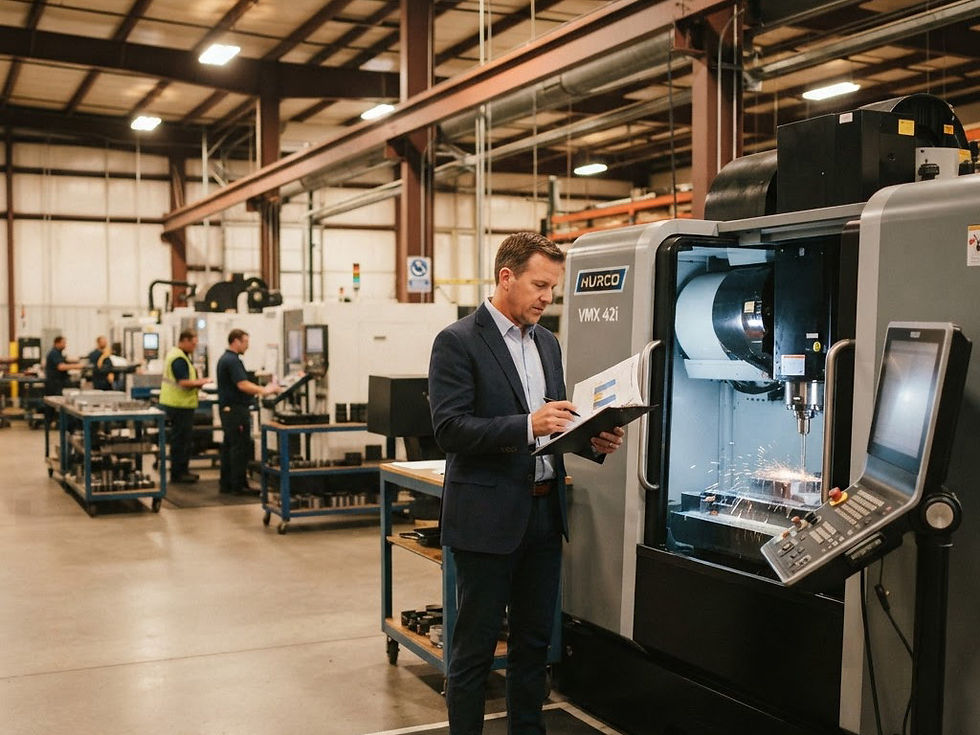
Key Takeaways
Manufacturing businesses have unique financing needs centered on equipment, inventory, and production cycle cash flow.
The SBA's new MARC program is the first revolving credit product designed exclusively for manufacturers.
Equipment-secured loans typically carry lower risk profiles, contributing to approval rates between 70% and 82% depending on lender type.
Matching your loan type to your specific need (equipment vs. working capital vs. expansion) is critical to getting the right terms.
An AI-powered business lender matching platform can save significant time by connecting you with lenders who already work with manufacturing profiles.
Table of Contents
Why Manufacturing Financing Is Different
Most small business lending content is written with a service business or retailer in mind. Manufacturing companies face a different set of financial dynamics. Production cycles create uneven cash flow. Equipment is expensive and depreciates on its own schedule. Raw materials must be purchased well before revenue arrives. And a single piece of machinery can cost as much as an entire year of payroll.
These realities mean the financing structures that work for a restaurant or a consulting firm are often poorly suited for a fabrication shop or a plastic extrusion operation. Financing for manufacturing companies needs to account for collateral-heavy balance sheets, longer asset lifecycles, and the layered capital needs that come with scaling production.
Understanding this context is the first step toward finding industrial business funding that actually moves your operation forward rather than creating new cash flow pressure.
Types of Manufacturing Business Loans
There is no single "manufacturing loan." Instead, manufacturers typically draw from several loan structures depending on what they need the capital to accomplish.
Equipment Loans and Leases
When you need to purchase machinery, an equipment loan lets the asset itself serve as collateral. This reduces lender risk and generally results in more competitive terms. According to the Equipment Finance Industry Fact Sheet for Manufacturing (2026), over 82% of businesses that acquired equipment used at least one form of financing, including leases, secured loans, or lines of credit. Equipment loans for manufacturing typically run 60 to 72 months, with SBA-backed options extending to 10 years. You can read more about how these structures work in our guide to equipment financing for small businesses.
Working Capital Loans
These short-to-medium-term loans help manufacturers cover payroll, utilities, raw material purchases, and other operating expenses during slow production periods or before large invoices are paid. A metal fabrication shop managing seasonal demand swings, for example, might use a working capital loan to stay staffed and supplied between contracts. Learn more about how these loans function in our working capital loans guide.
Business Lines of Credit
A revolving line of credit gives manufacturers flexible access to capital they can draw on and repay repeatedly. This is particularly useful for managing raw material costs that fluctuate with commodity prices. If you're managing inventory purchases tied to production schedules, a business line of credit for inventory may be a more efficient structure than a lump-sum term loan.
Term Loans
For planned expansions, facility upgrades, or large capital investments, a traditional term loan provides a fixed amount with structured repayment. A 5-year-old manufacturing firm with $2.1 million in annual revenue, for instance, seeking $320,000 to purchase new CNC machinery would likely pursue a term loan secured by that equipment. Our guide to business term loans covers the mechanics in detail.
SBA Loan Options for Manufacturers in 2026
The Small Business Administration has historically been one of the strongest resources for small manufacturers, and 2026 marks a significant expansion of that support. According to the SBA 2025 Annual Report, the agency introduced the Manufacturer's Access to Revolving Credit (MARC) program, the first SBA loan product designed exclusively for manufacturers. The SBA also eliminated all lender fees for manufacturers in FY26, meaningfully reducing the upfront cost of accessing government-backed capital.
SBA 7(a) Loans
The SBA 7(a) is the most flexible government-backed loan and can be used for equipment, working capital, or debt refinancing. A small-batch plastic extrusion company, for example, could use an SBA 7(a) to refinance high-interest debt and simultaneously purchase new energy-efficient molding equipment, consolidating obligations under a single, lower-cost structure.
SBA 504 Loans
The 504 is purpose-built for fixed assets including heavy equipment and real estate. It pairs a conventional lender with an SBA-backed portion, typically allowing manufacturers to finance major capital expenditures with a lower down payment than conventional loans require.
SBA MARC Program
For manufacturers managing seasonal raw material costs or fluctuating production demands, the new MARC revolving credit program is designed specifically for this scenario. A metal fabrication shop could apply under MARC to maintain a flexible credit facility that scales with order volume rather than locking into fixed monthly payments on a term loan.
Ready to explore which SBA or conventional loan type fits your manufacturing business? Contact Us and we'll help match you with lenders who specialize in manufacturing profiles.
Equipment Financing: The Core of Industrial Funding
For most manufacturers, equipment is both the largest expense and the most valuable asset. This dual role makes equipment financing a central pillar of industrial business funding strategy.
According to equipment loan and lease statistics for 2026, manufacturing and industrial equipment accounts for 13% of total equipment finance volume, with standard loan terms of 60 to 72 months. Equipment manufacturer captive finance companies reported an 82% approval rate for equipment loans in 2025, reflecting the lower default risk that collateralized equipment creates for lenders.
When you approach a lender with an equipment purchase, you're bringing built-in collateral to the table. That changes the risk calculation and typically results in more favorable terms compared to unsecured financing. Understanding whether your loan is secured or unsecured and what that means for your rate and approval odds is an important step before you apply.
Comparing Loan Options: A Data Table for Manufacturers
Loan Type | Best Use Case | Typical Term | Approval Rate (Est.) | Collateral Required |
Equipment Loan | CNC machines, molding equipment, heavy machinery | 60-72 months | 70%-82% | Equipment itself |
SBA 7(a) | Equipment, working capital, debt refinancing | Up to 10 years | Varies by lender | Business assets |
SBA 504 | Heavy equipment, facility acquisition | 10-25 years | Varies by lender | Fixed assets |
SBA MARC (2026) | Revolving credit for seasonal material costs | Revolving | New program | Business assets |
Working Capital Loan | Payroll, utilities, operating gaps | 6-24 months | Varies by profile | Sometimes unsecured |
Line of Credit | Raw materials, inventory, flexible draw needs | Revolving | Varies by profile | Sometimes unsecured |
Approval rate benchmarks sourced from ELFA and Crestmont Capital industry data. Individual results depend on business financials, credit profile, and lender criteria.
What Lenders Evaluate When You Apply
Whether you're applying through a bank, an online lender, or using a business lender matching platform, lenders evaluate manufacturing applicants through a consistent framework. Understanding what they look for gives you an edge before you submit anything.
The five factors most lenders assess are known as the 5 Cs: capacity, capital, conditions, character, and collateral. For manufacturers, collateral is often a significant advantage because equipment, inventory, and real estate all count. Our breakdown of what lenders look for in a business loan application covers each factor in depth.
For manufacturing applicants specifically, lenders also pay close attention to:
Revenue consistency across production cycles, not just annual totals
The age and condition of existing equipment on the balance sheet
Customer concentration risk (are 80% of revenues coming from one contract?)
Inventory turnover rates
Debt service coverage ratio relative to current loan obligations
Knowing your numbers before you apply, and being able to explain revenue fluctuations in terms of production cycles rather than business weakness, can meaningfully improve how lenders view your application. Review our guide on how to qualify for business loans in 2026 for a step-by-step qualification checklist.
How to Streamline Your Business Loan Application
One of the most time-consuming aspects of finding manufacturing business loans is identifying which lenders actually serve your industry and loan size. Many business owners waste weeks applying to lenders who don't work with manufacturers, only to receive declines that have nothing to do with their creditworthiness.
This is precisely where AI-powered business funding tools change the process. Rather than submitting applications blindly, a platform that uses data analysis to match your specific financial profile with qualified lenders allows you to compare business lending options that are already aligned with manufacturing borrowers. The equipment finance industry originated over $900 billion in new business volume in 2024, which means there is substantial lender activity in this space. The challenge is finding the right lender efficiently.
DirectLend AI is not a direct lender. It is an intelligent matching platform that analyzes your financial profile across dozens of data points and connects you with lenders suited to your situation. For a manufacturing company, that means being matched with lenders who understand equipment collateral, production-cycle revenue patterns, and SBA programs like MARC rather than starting from scratch with a generic loan marketplace.
To prepare a strong application, gather the following before you start:
Two to three years of business tax returns
Recent profit and loss statements and balance sheet
Equipment appraisals or purchase quotes if applying for equipment financing
Accounts receivable and payable aging reports
A brief summary of the loan's intended use and expected impact on revenue
If you want to find small business loans without submitting the same paperwork to a dozen different lenders, a matching platform with fast business financing capabilities is a practical starting point. You can also review what to expect on the timeline in our business loan application timeline guide.
If you're ready to compare business lending options tailored to manufacturing, Contact Us today and let's identify the best business loan lenders for your specific production and capital needs.
FAQs
What types of loans are available for manufacturing businesses?
Manufacturers can access equipment loans, SBA 7(a) and 504 loans, working capital loans, lines of credit, and the new SBA MARC revolving credit program launched in 2026 specifically for manufacturers.
Can manufacturing equipment serve as collateral for a business loan?
Yes. Manufacturing equipment is commonly accepted as collateral for secured business loans. This typically improves approval odds and can result in more favorable loan terms compared to unsecured borrowing.
What credit score do I need to get a manufacturing business loan?
Requirements vary by lender and loan type. Strong applicants in the 695+ credit score range typically access the most competitive rates. SBA loans may accept lower scores with compensating factors like strong revenue or collateral.
How long does it take to get approved for a manufacturing equipment loan?
Timelines vary. Online lenders can move in days while SBA loans may take several weeks. Using a lender matching platform that connects you with pre-qualified lenders can significantly reduce the overall time to funding.
Is the SBA MARC program available to all manufacturers?
The SBA MARC program is designed for small manufacturers and is accessed through SBA-approved lenders. Eligibility follows standard SBA small business size standards for the manufacturing sector. Contact an SBA lender or matching platform to confirm your eligibility.



Comments