Business Loan Lending Criteria: What Lenders Look for Before They Say Yes

Getting a business loan can feel like trying to crack a code. You submit your application, wait anxiously, and then wonder why you were approved for less than you needed or turned down entirely. The truth is, every lender evaluates your business through a set of lending criteria for business loans that rarely gets explained upfront.

Whether you are applying through a bank, an SBA program, or a direct lender like DirectLend.AI, understanding what lenders look for puts you in control. This guide walks you through each major criteria, how lenders weigh them, and what you can do before you apply to improve your chances of getting approved for the amount you actually need.
Key Takeaways
Lenders evaluate your business using several core criteria: credit score, time in business, annual revenue, cash flow, and collateral.
Most traditional banks require at least two years in business and a credit score of 680 or higher.
Online direct lenders often have more flexible requirements, making them a strong option for newer businesses.
Understanding the specific lending criteria for business loans before you apply helps you avoid unnecessary hard credit pulls and wasted time.
DirectLend.AI matches you with lenders based on your actual business profile, so you only see options you are likely to qualify for.
Table of Contents
What Are Business Loan Lending Criteria?
Business loan lending criteria are the specific factors a lender uses to evaluate whether a business qualifies for a loan and on what terms. These criteria determine not just whether you get approved, but how much you can borrow, what interest rate you pay, and how long you have to repay it.
Lenders use these factors to measure risk. The lower the risk you present, the better your loan terms will be. The criteria vary between lender types, but several core factors appear across nearly all of them.
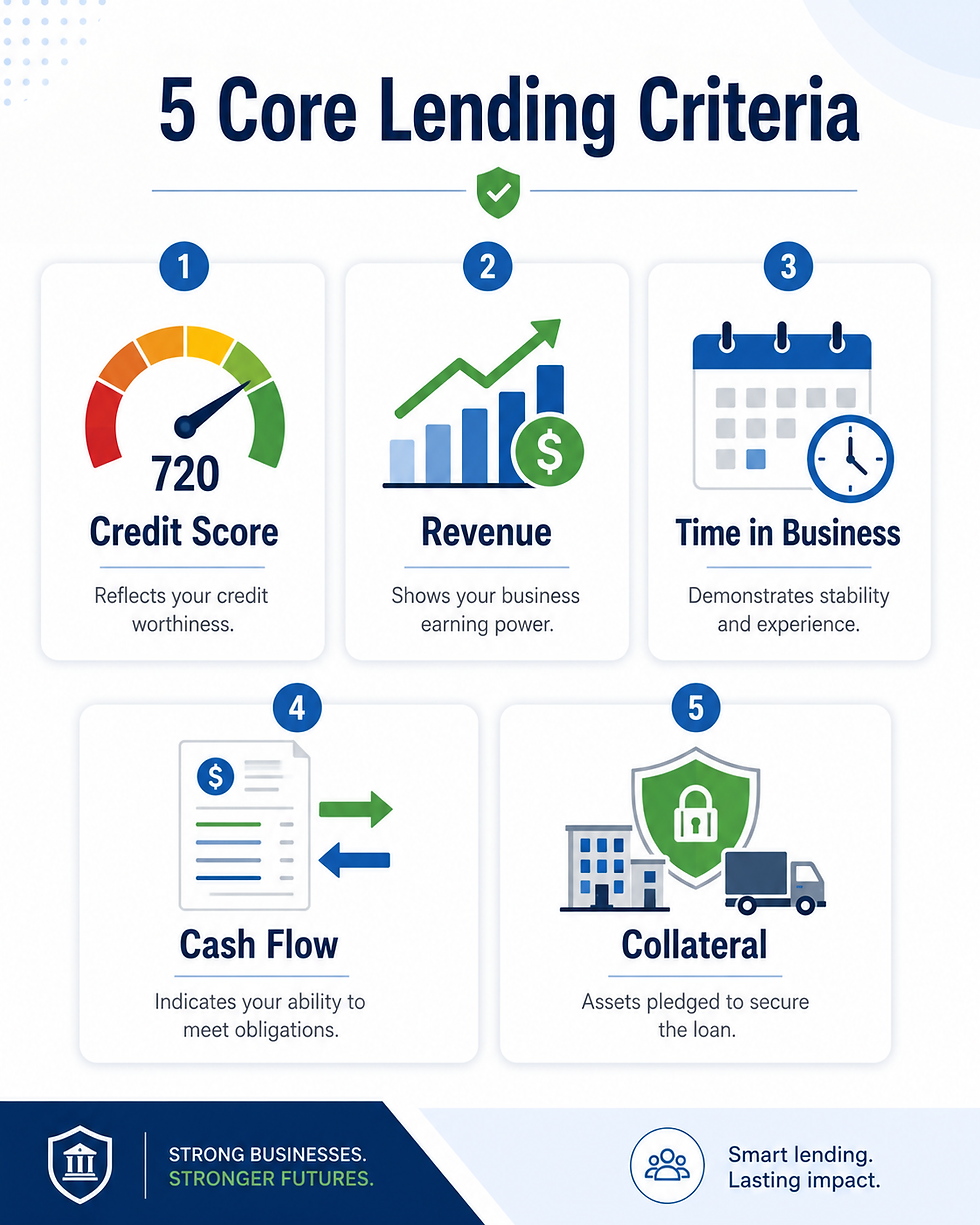
Credit Score: Personal and Business
Credit score is one of the most heavily weighted lending criteria for business loans. Lenders use it as a fast indicator of how reliably you pay your debts.
Most lenders look at two scores:
Personal Credit Score: Because many small businesses are closely tied to their owner, lenders often pull your personal credit score as part of the application. A score of 680 or higher generally qualifies you for traditional bank loans and SBA loans. Scores between 600 and 679 may open doors at online lenders and alternative financing options.
Business Credit Score: Your business also has its own credit profile through bureaus like Dun and Bradstreet, Experian Business, and Equifax Business. These scores reflect payment history with vendors, suppliers, and any existing business debt. Building a strong business credit profile before applying gives you an advantage.
What If Your Credit Score Is Low?
A low credit score does not automatically disqualify you. Some direct lenders for business loans weigh other factors more heavily, such as revenue consistency or asset value. According to the Federal Deposit Insurance Corporation (FDIC), fintech lenders now originate a growing share of small business loans, partly because they use alternative data points beyond the traditional credit score.
Time in Business Requirements
The length of time your business has been operating signals stability to lenders. Newer businesses carry more perceived risk because they have a shorter financial track record.
Here is how time in business typically affects your options:
Business Age | Typical Lender Options Available |
Less than 6 months | Microloans, startup grants, personal loans used for business |
6 to 12 months | Select online lenders, merchant cash advances |
1 to 2 years | Most online direct lenders, some SBA microloan programs |
2 years or more | Traditional banks, SBA 7(a) loans, full range of products |
If your business is under two years old, your best path is typically through an online direct lender or an AI-powered matching platform that connects you only with lenders whose minimum time-in-business requirements match your profile. You can learn more about how different types of business lenders set these thresholds in our lender types guide.
Annual Revenue and Cash Flow
Lenders want to know that your business generates enough money to repay the loan. Annual revenue and monthly cash flow are two of the most important signals they use.
Annual Revenue: Most lenders set a minimum annual revenue requirement. Traditional banks may require $250,000 or more annually, while online lenders may work with businesses generating as little as $50,000 to $100,000 per year.
Cash Flow: Revenue tells lenders how much money comes in, but cash flow tells them what is left after expenses. A debt service coverage ratio (DSCR) of 1.25 or higher is a common benchmark, meaning your business generates $1.25 for every $1.00 of debt obligations. Lenders typically review your last three to twelve months of business bank statements to assess this.

Collateral and Personal Guarantees
Collateral is an asset you pledge to secure a loan. If you default, the lender can claim that asset. Not every loan requires collateral, but offering it can improve your terms significantly.
Common Types of Collateral:
Real estate (commercial or personal property)
Equipment or machinery
Accounts receivable
Business inventory
Personal Guarantee: Even when a loan is technically a business loan, many lenders require a personal guarantee. This means you as the business owner are personally liable for repayment if the business cannot pay. SBA loans almost always require a personal guarantee from any owner holding 20% or more of the business.
If you prefer a loan without pledging assets, unsecured business loans from a direct lender are an option, though they typically come with higher interest rates to offset the lender's added risk.
Business Plan and Industry Type
Not all lenders require a formal business plan, but having one helps, especially for SBA loans and larger loan amounts. A strong business plan demonstrates that you understand your market, have a clear repayment strategy, and know how you will use the funds.
Lenders also consider your industry. Some industries are classified as higher risk due to their volatility, seasonal revenue patterns, or regulatory environment. Common examples include restaurants, construction, and retail. Higher-risk industries may face stricter criteria or need to provide more documentation.
Ready to find out which lenders match your business profile? DirectLend.AI uses intelligent matching to show you real business loan offers based on your actual criteria, without hurting your credit score. See your options in minutes.
How Lending Criteria Differ by Lender Type
The lending criteria for business loans vary significantly depending on where you apply. Knowing this in advance helps you target the right lender for your situation rather than applying broadly and collecting rejections.
Lender Type | Min. Credit Score | Min. Time in Business | Min. Revenue | Collateral Required? |
Traditional Bank | 680+ | 2+ years | $250K+ annually | Often yes |
SBA Lender | 650+ | 2+ years | Varies by program | Often yes |
Online Direct Lender | 580+ | 6 months+ | $50K–$100K+ | Sometimes |
AI Matching Platform (DirectLend.AI) | Flexible | 6 months+ | Flexible | Depends on lender |
Microloan Programs | Flexible | Startups eligible | Flexible | Sometimes |
According to data from the U.S. Small Business Administration, SBA loan programs are designed to expand access to capital for small businesses that may not meet conventional bank standards, making them a valuable alternative for businesses that just miss traditional thresholds.
How to Improve Your Approval Odds Before Applying
The best time to work on your loan eligibility is before you need the money urgently. Here are practical steps you can take now to strengthen your position.
1. Check and Clean Up Your Credit Reports Pull your personal and business credit reports before applying. Dispute any inaccuracies. Pay down existing revolving debt to lower your credit utilization.
2. Separate Your Business and Personal Finances Open a dedicated business checking account if you have not already. Lenders want to see clean, separate business bank statements.
3. Document Your Revenue Consistently Use accounting software to track income and expenses. Lenders are more comfortable with businesses that have organized, consistent financial records.
4. Build Your Business Credit Profile Register your business with Dun and Bradstreet to establish a DUNS number. Pay vendor invoices on time. Apply for a business credit card and keep utilization low.
5. Know Your Numbers Before You Apply Calculate your debt service coverage ratio, average monthly revenue, and total outstanding business debt before you approach any lender. Walking in prepared signals professionalism and reduces back-and-forth delays.
6. Use a Smart Matching Platform Rather than applying to multiple lenders and triggering multiple hard credit inquiries, use DirectLend.AI to see which lenders are most likely to approve you based on a soft inquiry. This preserves your credit score while showing you real options.
Frequently Asked Questions
What credit score do I need for a business loan?
Most traditional lenders require a personal credit score of 680 or higher. Online direct lenders may approve scores as low as 580. SBA loan programs typically require 650 or above.
How long does a business need to be open to get a loan?
Banks and SBA lenders usually require at least two years in business. Many online lenders will work with businesses open for as little as six months if revenue and cash flow meet their minimums.
What documents do lenders typically require for a business loan?
Lenders commonly request the last three to six months of business bank statements, two years of business tax returns, a profit and loss statement, and proof of business ownership or registration.
Do all business loans require collateral?
No. Unsecured business loans do not require collateral, but they typically carry higher interest rates. Secured loans offer better rates in exchange for pledging a business or personal asset as security.
What is a debt service coverage ratio and why does it matter?
A debt service coverage ratio (DSCR) measures your cash flow against your debt obligations. A DSCR of 1.25 means your business earns $1.25 for every $1.00 of debt payments due. Most lenders prefer a ratio of 1.25 or higher.
Ready to Apply? Start with DirectLend.AI
Understanding the lending criteria for business loans is the first step. Applying with the right lender is the second.
DirectLend.AI takes the guesswork out of the process. Instead of applying blindly and hoping for the best, you answer a few quick questions about your business and our AI-powered platform matches you with lenders whose criteria align with your profile. No hard credit pull. No wasted applications. Just real options from lenders who want to fund businesses like yours.
Visit DirectLend.AI today to see your personalized business loan matches in minutes.
About the Author
The DirectLend.AI team is made up of business finance specialists and fintech professionals dedicated to helping small business owners access the capital they need to grow. DirectLend.AI operates as an AI-powered lending marketplace, connecting entrepreneurs with vetted lenders across the United States. Learn more at directlend.ai.
References
Federal Deposit Insurance Corporation (FDIC) Small Business Lending Data — Supports data on fintech lenders' growing share of small business loan originations
U.S. Small Business Administration (SBA) Loan Programs — Supports information on SBA eligibility criteria and program access
DirectLend.AI Business Lender Types Guide — Internal reference on lender categories
DirectLend.AI: How to Find the Right Small Business Loan Lenders — Internal reference on lender selection


Bài của bạn trình bày ngắn gọn mà vẫn rõ ràng, mình đọc lướt vài dòng là nắm được ý chính nên thấy khá dễ theo. Cảm ơn bạn đã chia sẻ nhé. Mình cũng có thói quen xem thống kê XSMB hằng ngày, nhưng trước đây cứ phải mở nhiều chỗ khác nhau nên mất công và dễ quên. Sau đó mình tự gom lại cho tiện, kiểu lưu sẵn một trang trên soicau247.com để lúc cần chỉ mở ra xem nhanh, đỡ phải lục lại từng nơi. Mình xem chủ yếu cho quen tay thôi, ai cũng hay cập nhật theo ngày thì có thể xem thêm ở đây: https://soicau247.com/xsmb-thu-6-ket-qua-xo-so-mien-bac.html.